“Jonathan Cott could drive the tour bus in the City of God. Knowledge esoteric and exoteric oozes out of his every pore,” Tom Robbins enthused in a review of Forever Young—a 1977 collection of eight Cott interview/profiles. “It’s Cott’s own amazing mind, interacting with his subjects,” Robbins declared, “that makes Forever Young such an appetizing platter.”

Indeed, that book—which included brilliant profiles of and conversations with figures as diverse as Maurice Sendak, Glenn Gould, Henry Miller, Oriana Fallaci, and Werner Herzog—attested to the fact that Jonathan Cott had managed, as Larry McMurtry said, “to construct something like a new form, the essay-interview.”
Cott’s signature style—a conjoining of his dazzlingly eclectic knowledge with his wonderfully unaffected, child-like curiosity—informed his superb introductions and charged his interviews with an air of discovery and anticipation which produced exchanges that were deeply insightful and, often, unexpectedly revealing and rewarding.
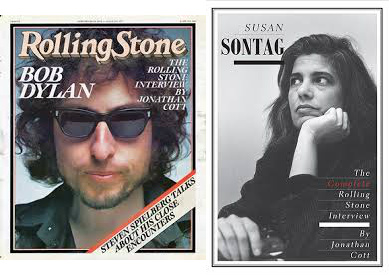
The interview/profiles that comprised Forever Yong were originally published in Rolling Stone magazine. As an original contributing editor, Cott’s interviews and writings regularly graced the pages of RS from its inception in 1967 throughout the 1970s. His work as the magazine’s first “European correspondent”—while he was studying children’s literature in England—provided him with an opportunity to interview such rock luminaries as John Lennon and Yoko Ono, Mick Jagger, Ray Davies, and Van Morrison.
However, rock music was but one of many subjects that Cott addressed in the pages of RS. His catholicity of musical passions and interests was reflected in his conversations with and commentaries on the works of musicians as varied as Igor Stravinsky, Virgil Fox, and Michael Tilson Thomas. Further, Cott’s eclectic body of work—which included examinations of and expositions on film, literature, poetry, parapsychology, theatre, mythology, science, and children’s literature—was consistently distinguished by his compelling intelligence, insight, and enthusiasm for the subject(s) at hand.

In 1977, I wrote Jonathan Cott a fan letter in order to salute his consistently outstanding contributions to RS and, specifically, his wonderful interview—“Reflections Of A Cosmic Tourist”—with Henry Miller. Much to my surprise and delight, Jonathan replied. Moreover, he was extremely generous in making complimentary remarks about my writing.
After we had exchanged a second round of letters, I set about going through my substantial collection of back issues of RS and, in reviewing Jonathan’s work, I came to understand that we shared an intriguing commonality of interests: everything from baseball, the Beatles, and Bob Dylan …to parapsychology and film … to seeking after truth and waking up! After immersing myself in Cott’s work, I decided that I wanted to write Jonathan a real letter … a man-sized letter … a letter of honest proportions.
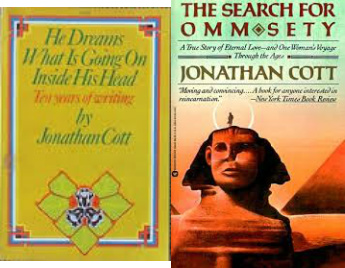
During that period, I had begun to take on the rather formidable, but irresistible task of writing an autobiographical book about my study of G.I. Gurdjieff and The Fourth Way. As I delved into Jonathan Cott’s work, I began to think about a statement I had recently come across from a writer—I believe it was John Fowles—to the effect that ‘every writer has an ideal reader.’ In contemplating my proposed writing projects, I realized that Jonathan Cott was my ideal reader.
Thus, I set about writing my book as “An Open Letter To Jonathan Cott.” And with that decision, I began a very strange and improbable journey of some twenty years—marked by incomprehensible futility and frustration—before finally completing my book, entitled But I’ll Know My Song Well …. The dedication read: “For Jonathan Cott: ‘May you stay forever young.’”
In some strange sense, Jonathan Cott was with me throughout my long, strange trip. He was not lost, so much as displaced in my scheming and dreaming.
An excerpt from Jonathan Cott’s first reply to me, June 13, 1977:
Dear Jim:
Thanks for your letter—I’m expecting to find a novel by you—or perhaps a memoir, travel book, book of poems, whatever. Your writing is the best thing I’ve seen in a long time …. Again, thanks for your words, and I hope we meet up one day.
Jonathan
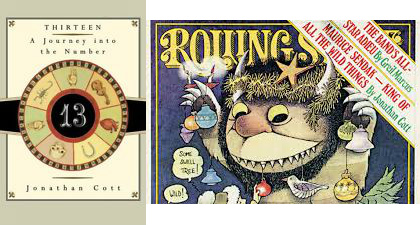
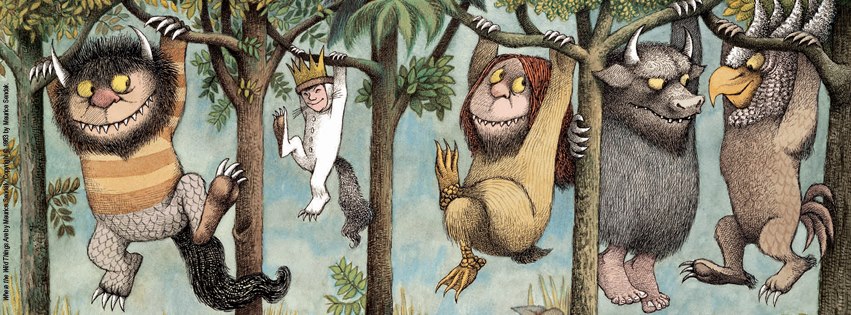
 James A. Moffatt