The following is an excerpt from my unpublished book, But I’ll Know My Song Well, in which I attempted to relate the impact of mystical teachings on my understanding of myself and the world to the transformation of meaning which, I believe, is at the heart of Joseph Heller’s brilliant novel, Catch-22.
Catch-22 is my favourite novel, and I have sometimes been accused—justifiably so—of trying to connect or relate everything, that happens to or interests me, to that book. I can’t help myself. From the first time I was introduced to Yossarian—the bombardier who lives in a world that is as absurd as it is inescapably terrifying and cruel—I felt an immediate, visceral affinity with him.
Ostensibly, his predicament is that he no longer wishes to fly combat missions—the war is as good as won—and yet he must, because Colonel Cathcart, his vainglorious commanding officer, wants to be a general and therefore keeps raising the number of missions necessary for a complete tour of duty. Yossarian’s only hope is to go crazy and be grounded by Doc Daneeka, the squadron’s medical officer. But when he asks him to do so, he finds that it isn’t that easy—there’s a catch:
There was only one catch and that was Catch-22, which specified that a concern for one’s safety in the face of dangers that were real and immediate was the process of a rational mind. Orr was crazy and could be grounded. All he had to do was ask; and as soon as he did, he would no longer be crazy and would have to fly more missions. Orr would be crazy to fly more missions and sane if he didn’t, but if he was sane he had to fly them. If he flew them he was crazy and didn’t have to; but if he didn’t want to he was sane and had to. Yossarian was moved very deeply by the absolute simplicity of this clause of Catch-22 and let out a respectful whistle.
“That’s some catch, that Catch-22,” he observed.
“It’s the best there is,” Doc Daneeka agreed.
While I had always identified with Yossarian, I came to realize—after I had more fully inhabited and absorbed the meaning of Catch-22—that my allegiance was misplaced. Yossarian is the protagonist of Catch-22, but it is his friend, Orr, who is its hero.
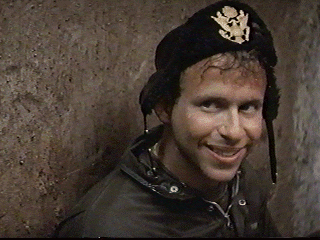
Orr is an eccentric, buck-toothed, apple-cheeked, gnome-like, smutty-minded rustic, who seems oblivious to all the horror and terror of his situation: happily continuing to fly missions, even though he draws flak like a magnet and, therefore, is shot down with improbable regularity. Orr is both immensely practical and implausibly innocent. His diligent and indefatigable tinkering has made the tent, which he shares with Yossarian, the envy of the squadron.
Yossarian cannot help but be impressed and thankful, but he is driven to thoughts of homicide whenever Orr begins one of the impossibly tedious and exacting tasks—such as fixing the valve on the stove he is installing in their tent—which he performs regularly with agonizing precision and interminable patience, as much, Yossarian believes, to torment him as to make the ostensible repairs. Orr’s devotion to every detail, no matter how small, and his alacrity in persevering, against all odds, without expressing doubt or complaint, is so thoroughly foreign to Yossarian that it fills him with nausea and dread.
On the other hand, Yossarian reacts to Orr’s naïveté with fear and an ardent desire to protect him. He is all too familiar with the host of unscrupulous agents and malicious forces that will undoubtedly set upon and cheat, rob, deceive, screw, and in every way possible, victimize such an obvious and inviting mark. But Yossarian, who is closer to Orr than anyone else, underestimates him. He knows him, but he does not understand him—for Orr has a secret, which is as invisible to everyone as Snowden’s was to Yossarian. And it is every bit as shocking.
“Why don’t you ever fly with me?” Orr asks Yossarian, knowing full well that Yossarian has gone to his superiors and asked specifically to not be assigned to Orr’s flight crew. “You really ought to fly with me, you know. I’m a pretty good pilot, and I’d take good care of you,” Orr assures Yossarian. “I may get knocked down a lot, but … nobody’s ever been hurt in my plane.”
“Are you trying to tell me something?” Yossarian asks suspiciously.
“I’m trying to tell you why that big girl with the shoe was hitting me on the head that day,” Orr replies, changing the subject to an oft-discussed incident, which had occurred in the brothel that they frequent in Rome.
There, in the hallway outside of his room, an astonished audience of his friends and their whores had witnessed the bizarre spectacle of Orr laughing uncontrollably as his whore beat him repeatedly over the head with her shoe, until an especially savage blow finally rendered him unconscious. It is an event that no one can understand or explain and which Yossarian can never forget, because Orr keeps bringing it up: teasing him, by offering to explain what had occurred, only to pull back from any disclosure once Yossarian has admitted how desperately curious he is to know the meaning of what was happening.
What was happening was that Orr was neither the innocent nor the dolt that everyone assumed he must be. Orr had decided to escape. Like Yossarian, he was no longer willing to fly combat missions, but unlike Yossarian, he understood that it would be useless to protest or appeal to the reason or good will of the authorities who had placed him in this intolerable situation. His opposition would only evoke a reaction in kind—a conflict which he could not win. Orr realizes that his only hope lies in adopting a new way of thinking: one which is organized around and applicable to the idea of escaping. And so, from the moment he makes that decision, everything he does is undertaken with that aim in mind. He begins to practise being shot down. To the amazement of those who end up in the sea with him, after having to ditch, he follows the survival procedures—which everyone knows are a bad joke—as if his life depends upon them. Thus, while waiting to be rescued, he gets everyone into the yellow rubber raft provided, and assumes the posture and responsibilities of the captain of a ship with an earnestness that convinces all those present that he is a hopeless idiot. He sets about surviving by examining and availing himself of all resources: distributing soggy chocolate bars, finding bouillon cubes and making soup, serving tea, releasing marker dye and shark repellent, setting out fishing line to catch cod (because it can be eaten raw), attempting to row with the pathetic little blue oar that some twisted functionary has been perverse enough to provide, and spreading out the waterproof map and compass on his knees—all the while grinning crazily and reassuring himself, by giggling goofily, that everything will be all right.
Of course, Orr doesn’t tell anyone that he doesn’t want to fly any more missions. Quite the contrary, he continues to fly in order to practise crash-landing and ditching in the sea. Because the idea is so inconceivable, no one ever gives it any consideration. To practise being shot down. Really! It’s preposterous. If someone were to try something like that, eventually they would be killed.

Of course, everyone who flies with Orr and Yossarian is practising not being shot down, and the regularity with which their numbers dwindle promises that eventually they will all be killed—especially since Colonel Cathcart continues to raise the number of missions they must fly.
So Orr gladly continues to fly his missions, convincing everyone who knows him that he is crazy. But Orr is sane to fly more combat missions because he has faith. His mind is open to possibilities not revealed by sense-based thinking, which is the real source of and authority underlying the dilemma in which Yossarian is ensnared. He has a method of self-transformation, and as such, is no longer a slave to the terrible machinery of life in which everyone is turning.
Orr has within himself another system. By this, he finds a new relation to what he experiences. Ideas, different from those he has acquired from brute-life, have entered and awakened his mind. In his intimate conversation with himself, he talks to himself in a new way, and, as he listens, his understanding of the meaning of these ideas gradually unfolds. Consequently, he is in the world, but not of it.
Of course, no one but Orr knows this; it is an invisible fact. So when Orr is shot down and is separated from the rest of his crew—drifting away, alone on his raft, into a storm—Yossarian presumes, like everyone else, that his friend has been lost at sea.
Yossarian could never understand Orr because he takes everything about him on a superficial, literal level. He is so thoroughly attached to his perspective that, just as he can never do anything other than react to all the horror and absurdity that assaults him, he can never penetrate Orr’s meaning. He has eyes but he cannot see, he has ears but cannot hear. Orr keeps dropping hints, but cannot tell Yossarian the truth directly; he must discover its meaning for himself. Yossarian suspects that Orr is up to something, but it never dawns on him that everything Orr is doing and keeps repeating to him points to the idea that he is planning to escape. Yossarian is simply incapable of imagining how Orr has radically altered everything by changing its meaning.
 James A. Moffatt